You Be the Judge!

Fair-goers can compare judging skills alongside Rock County 4-H’ers next week as the general livestock team practices for the upcoming Minnesota State Fair competition.
Today, Thursday, July 27, and Friday, July 28, prior to the swine, sheep, goat and beef shows, participants can view the designated species and mark their judge’s cards prior to the class of animals entering the ring.
Those who match the judge’s selection of the top four animals in order of preference could earn a prize.
Prizes for the public are awarded after each show.
Winning 4-H’ers, who judge all four species, are announced at the Parade of Champions on Saturday, July 29.
The idea behind the “Mark That Card” event came from Gabryelle Gilliam, Rock County Extension Service’s summer intern.
The event has two purposes, she said.
“How do we get people to come to the shows and how do we let the public know a lot more happens behind the scenes?” she said.
Gilliam along with local 4-H program coordinator Chelsey Asche and general livestock coach Stacy Mente were also brainstorming about how to arrange for more general livestock team practices.
“We all agree that livestock judging builds critical thinking and public speaking skills for youth,” Asche said. “We wanted to find a way to get more of our Rock County Youth excited about judging.”
Opening the contest to everyone promotes learning about livestock and an understanding of 4-H livestock judging.
Once all 4-H animals are at the fairgrounds Wednesday night, four animals in each species will be chosen for the judging event and their stalls marked. All animals appear in the same judging class.
Because more than four animals may be in the same class, final results would be the order that the judge places the animals, minus the ones not in the contest, Gilliam said.
Participants rank the designated animals 1 through 4 with 1 being the top animal, she said.
To be eligible for the contest judging cards are turned in prior to the start of each classes.
The 8 a.m. Thursday, July 27, swine show is the first event class followed by the goat show at 2 p.m. and sheep at 3:30 p.m.
Friday’s 8 a.m. beef show ends the “Mark That Card” judging contest.
Judging cards are located outside each of the livestock barns.
Gilliam began her internship with Rock County 4-H in May.
The Washington, Kansas, native will be a junior at Kansas State University. She recently added agricultural education to her animal science and industry major.
“I wanted to try it to know if I wanted to make it my major,” Gilliam said.

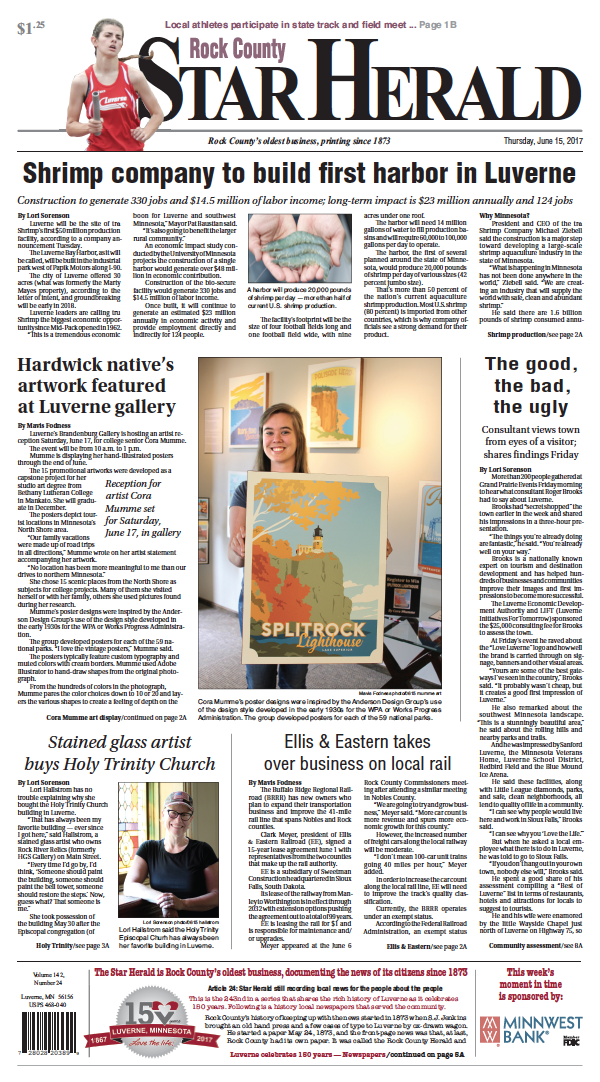
Shrimp company to build first harbor in Luverne

Luverne will be the site of trū Shrimp’s first $50 million production facility, according to a company announcement Tuesday.
 
The Luverne Bay Harbor, as it will be called, will be built in the industrial park west of Papik Motors along I-90.
The city of Luverne offered 30 acres (what was formerly the Marty Mayes property), according to the letter of intent, and groundbreaking will be early in 2018.
Luverne leaders are calling tru Shrimp the biggest economic opportunity since Mid-Pack opened in 1962.
“This is a tremendous economic boon for Luverne and southwest Minnesota,” Mayor Pat Baustian said.
“It’s also going to benefit the larger rural community.”
An economic impact study conducted by the University of Minnesota projects the construction of a single harbor would generate over $48 million in economic contribution. 
Construction of the bio-secure facility would generate 330 jobs and $14.5 million of labor income. 
Once built, it will continue to generate an estimated $23 million annually in economic activity and provide employment directly and indirectly for 124 people. 
The facility’s footprint will be the size of four football fields long and one football field wide, with nine acres under one roof.
The harbor will need 14 million gallons of water to fill production basins and will require 60,000 to 100,000 gallons per day to operate.
The harbor, the first of several planned around the state of Minnesota, would produce 20,000 pounds of shrimp per day of various sizes (42 percent jumbo size).
That’s more than 50 percent of the nation’s current aquaculture shrimp production. Most U.S. shrimp (80 percent) is imported from other countries, which is why company officials see a strong demand for their product.
 
Why Minnesota?
President and CEO of the trū Shrimp Company Michael Ziebell said the construction is a major step toward developing a large-scale shrimp aquaculture industry in the state of Minnesota.
“What is happening in Minnesota has not been done anywhere in the world,” Ziebell said. “We are creating an industry that will supply the world with safe, clean and abundant shrimp.”
He said there are 1.6 billion pounds of shrimp consumed annually in the United States and 80 percent of it is imported largely from Southeast Asia. 
The advantage to domestically raised shrimp is that the process is sustainable, antibiotic-free and environmentally responsible, Ziebell said.
“We are often asked, ‘Why raise shrimp in Minnesota?’ And the answer is because the feed is here,” he said. 
“Economically and environmentally it makes much more sense to raise shrimp near their food source than to ship feed to shrimp raised in coastal ponds thousands of miles from the U.S. market.”
Baustian said that’s another reason shrimp production is so beneficial for Luverne and the region. 
“We are an agribusiness community,” he said. 
“The shrimp are fed primarily soybeans, corn and hard red wheat, which positively affects the bottom line of every farmer in Minnesota. … Anytime we can help our local farmers is a plus for Main Street Luverne. When our farmers do well, the whole region does well.” 
 
Research and training in Balaton; hatchery and processing in Marshall
Minnesota-based Ralco owns the shrimp company and the patented production technology. It has been fine-tuning the process in Balaton (in the former school building) for the past two years.
“Until now, the technology to effectively raise shrimp in the Midwest United States on a large scale did not exist,” Ziebell said. “Now it does and we have proven it.” 
A training facility “Balaton Bay Reef” will begin this summer in Balaton adjacent to the trū Shrimp Innovation Center and Laboratory. Personnel will train there to work in the shrimp production Harbors — which will eventually also be built in other Minnesota locations.
The company also issued a letter of intent to locate the first shrimp hatchery in Marshall to prepare more than 8,000,000 pounds of shrimp estimated to be produced by a single Harbor annually.
Marshall and Balaton will serve as the hub for aquaculture breeding and processing.
Several states were vying for the establishment of trū Shrimp headquarters and Harbors. 
Minnesota State Senator Bill Weber and Representative Chris Swedzinski were strong proponents for the development of a shrimp aquaculture industry in Minnesota.
They noted that shrimp production involves a biomedical compound called chitosan that is captured from shrimp shells as they are shed. 
In addition to the multiple biomedical applications, it will spur additional economic benefits for the state and region.

Speedway hosts Buffalo Days event

Rock County Speedway played host to three classes of racing during the Buffalo Days race event Saturday.
Luverne’s Tom Walker finished first in the factory stock class. Keith Hieronimus of Worthington placed second and Luverne’s Tanner Baustian finished third in a field of twelve drivers.
Local drivers Jacinda Walker and Ben Peters placed fourth and fifth respectively.
In the mini-mod division, Adam Ackerman of Mason City, Iowa, placed first. Taton Hansen of Spicer finished second, followed by Owatonna’s Anthony Kramer in third place.
Russ Huisman of Baltic, South Dakota, came out on top of the mini-sprints class. Nick Kirkegaard of Sioux Falls finished in second place and Brooke Wegener, also of Sioux Falls, placed third. 

Subscribe to

You must log in to continue reading. Log in or subscribe today.