Court is in session

Baseball is a nuanced game with many rules and even more details.
Learning all there is to know about baseball can be a daunting task for young players and even longtime fans of the game.
That’s where the Luverne Cardinal Kangaroo Court comes into play.
Luverne High School varsity baseball coach Mike Wenninger has led the LHS program for over 20 years.
He’s also coached the summer Junior Legion team for all that time.
The team is made up of mostly ninth- and 10th-grade players. The coach uses those many summer games to teach his future varsity Cardinals the finer details of not only the game of baseball, but life lessons in general.
For much of that time, Wenninger’s Junior Legion teams have used a system he calls Cardinal Kangaroo Court to help his young players learn the many lessons he wants to teach.
“The Kangaroo Court allows us to teach the kids those little things but also kind of make light of a situation that doesn’t have to be made bigger,” Wenninger said.
“Another benefit is we coaches don’t have to nag and repeat ourselves over and over,” he said. “The kids take care of it in the court.”
In fact, the players are actually in charge of the system.
Before, during or after a game, team members who notice a mistake or infraction made by themselves or another player say, “There’s a bang.”
A “bang” could be a mistake made on the field, forgetting to do a job, being late, not bringing needed equipment, wearing the wrong color belt or socks with the uniform or even asking a parent to come into the dugout.
“It could be things like missing a sign, not running with two outs, or anything on or off the field that impacts the team,” Wenninger said.
“Bangs aren’t for physical errors made on the field during a game, more the mental aspects of the game,” he added.
Wenninger said the physical aspects of the game are worked on during practice.
“Bangs are a way for the kids to hold each other accountable for the things we try to teach and talk about over and over at practice,” he said.
That peer accountability comes during team meetings after each game.
Team members hold court and bring up any bangs that occurred. The team then decides the cost of the infraction, normally 25 cents.
Sometimes repeat offenses can garner slightly larger fines.
At the start of each season, team members vote on two players to serve as the accountants for the Kangaroo Court.
The accountants are responsible for maintaining records and collecting the money from players.
At the end of the season, all money collected goes back to the team.
“It could be ice cream treats, baseballs, partially paying for a team bat, that kind of thing,” Wenninger said.
This year’s accountants are Kaden Anderson and Casey Sehr.
Anderson keeps detailed records in his cellphone and Sehr collects the money.
“The whole system is run by the kids,” Wenninger said. “They decide on the infractions and the amount owed. Everything is voted on by the team, and majority rules.”
Wenninger said the peer accountability is what makes the Kangaroo Court work.
“The kids are learning to avoid the infractions just by watching for them and hearing them called out on others,” he said. ”They’re learning what not to do in order to avoid that bang.”
Sehr and Anderson agree the court works.
“It keeps us from messing around and teaches us what we need to know,” Anderson said.
“It’s a fancy way to make sure we don’t touch the hot stove twice,” Sehr said, repeating one of his coach’s often-used analogies.
This year the court system has collected just under $20 total from team members.
According to the accountants, there is still a little money owed by team members.
“We have a group chat that we use to remind them,” Anderson said, looking down at his notes on his cellphone.
 “This year’s been better than last year,” he said. “We’re learning.”

Great American Outdoors Act is big deal, great news

When I need a “pick me up,” I just go for a wildlife ride and look for God’s creatures. They seem to have made it through thousands of years of ups and downs, and last week they got a really, really big surge upwards.
Congress passed the Great American Outdoors Act.
I will provide a little background story first. In 1964 Congress passed the Land and Water Conservation Fund. This fund needed to be reauthorized periodically. This directed $900 million that the government received from gas and oil drilling royalties to this dedicated fund. As soon as it was passed, that same Congress started raiding the fund. Sounds a lot like Social Security to me. As the years passed, they habitually funded very small portions of what was promised.
The money that did get deposited in the fund was divided up and used by the states to acquire additional acres and improve the existing public lands acres. I don’t call them public lands. I call them citizen-owned lands. These are acres we can all use to recreate, camp, fish, bird watch or any other compatible use. I believe that every citizen, regardless of their economic status, should be able to enjoy the outdoors. Citizen-owned lands are the only way this is allowed to happen.
Each year dozens of conservation organizations lobbied hard for full funding. It never happened. This year was different. In an election year many unusual things happen. The Land and Water Conservation Fund was made permanent, no longer needing reauthorization, and so was the maximum funding of 900 million dollars. These funds would still come from oil and gas revenues but if they fall short, the funding must come from somewhere else. If you consider yourself a sportsman or sports woman, this is the biggest news to hit the outdoor press in 50 years.
In addition to permanent and fixed funding, the act also authorized $9.5 billion to be spent over the next six years to reduce the backlog of maintenance issues in our national parks.
With the Covid-19 restrictions, more and more folks are spending time outside. It was this increase in outdoor interests that helped fuel the support for the bill’s passage and its ultimate success. This is a monumental conservation bill, one unlike any other I have ever seen before and on a scale much larger than anything in the past.
Congressional representatives from some western states were adamantly opposed to this legislation. Those states already have upwards of 50 to 70 percent of their lands in federal ownership. I say spend those dollars in areas that have almost no citizen-owned lands at all. My county has less than 2 percent of its acres in any form of citizen-owned property.
It has historically been the congressional Republicans that have opposed this type of legislation. With the slim margins of each party’s majority in both houses of Congress, even one or two seats can turn the tide. Hence the overwhelming bi-partisan support this bill received.
All I know for a fact is that most of the conservation work that has been done in the past 75 years has been done with the money hunters and fishers have spent on licenses. This is one of the first bills that will spread out the responsibility of protecting and preserving our natural resources to all of the folks who enjoy them.
This is great news and way overdue. If you value wild places and the creatures that live there, this is a very big deal. Google “Great American Outdoors Act” and thank the folks who made it happen. It bears repeating, Today is a very great day and conservation interests have waited since 1964 to see it.
 
Scott Rall, Worthington, is a habitat conservationist, avid hunting and fishing enthusiast and is president of Nobles County Pheasants Forever. He can be reached at scottarall@gmail.com. or on Twitter @habitat champion.

'Who do you say that I am?'

Read: Matthew 16:13-20 (This is the Gospel Reading for Sunday, Aug. 23)
“Who do you say that I am?” This question from Jesus is right in the middle of Matthew’s Gospel. It’s meant to be the key question for us to consider.
Have you ever noticed how people remember where they were when significant events happened? Perhaps you’ve heard the question, “Where were you when ____ happened?” Sometimes the reference is to momentous historical events – things that remain in our collective memory.
Other times significant personal happenings are referred to such as when you got engaged or heard you were expecting your first child.
So, Matthew mentions that Jesus and the disciples were in the region of Caesarea Philippi when Jesus asked the most significant of questions.
First, Jesus wonders if the disciples have been paying attention to what other people might be saying, “Who do people say that the Son of Man is?” The disciples’ response shows they have been listening, at least to some extent. “Some say John the Baptist, some say Elijah, some say Jeremiah. …” And, in truth, none of those are bad answers, but they all stop short of realizing the complete identity of Jesus.
So, Jesus poses the question directly to the disciples, “Who do you say that I am?”
If they have been paying deep attention so far, they would know that he is “Emmanuel – God with us.” They would know that he is one who can work miracles such as feeding a large crowd of 5,000 with supplies that seemed only enough for five. They would know that he is the one who can walk on water and one whom wind and waves obey.
The disciples are deep into their education about Jesus, and Peter speaks up to say, “You are the Messiah, the Son of the Living God.” Peter is praised for his answer! He realizes that Jesus is more than a man, more than a prophet, more than a teacher. He is the Messiah! He is the Savior!
       Matthew writes his gospel in a style that is meant to speak to us as well. The question to the disciples answered by Peter is meant to jump off the page across the centuries for us to answer. “Who do you say that I am?”
       Who do you say that Jesus is? Perhaps you have answered this question well and completely at some point in your life. Maybe you can still remember where you were when you first professed Jesus Christ as your Lord and Savior. Perhaps some important life event or relationship helped you make this most important realization.
For others, maybe the journey of faith has been more circuitous and gradual, but you still have that deep conviction that “Jesus is Messiah, Lord, Savior.”
Perhaps some need to consider the question freshly today. “Who do you say that Jesus is?” That is the key question!

Church News Aug. 20, 2020

The Star Herald reached out to churches for their worship information in the absence of in-person worship services, due to coronavirus social distancing. Those that responded are listed here. Those that would like to have information posted here should call the Star Herald or email editor@star-herald.com.
 
St. Catherine Catholic Church
203 E. Brown St., Luverne
St. Catherine Ph. 283-8502; www.stscl.org
Monsignor Gerald Kosse, Pastor
Public mass will be celebrated with a limit of 50 percent capacity of the church. Masses: 9 a.m. Wednesday, 10 a.m. Friday and 8:30 a.m. Sunday. No mass, communion service or rosary at care centers at this time. 5 p.m. Saturdays and 8:30 a.m. mass will be live streamed on Facebook at https://www.facebook.com/pg/stccluverne/videos/. Visit www.stscl.org for more information.
 
Luverne Christian Reformed Church
605 N. Estey St., Luverne
Office Ph. 283-8482; Prayer Line Ph. 449-5982
www.luverncrc.com — office@luvernecrc.com
Roger Sparks, Pastor
We are streaming Sunday services live on Roger Sparks’ Facebook page at 9:30 a.m. and 6:30 p.m. Send him a friend request if you’re not connected. You may also visit our website for delayed broadcasts. Also our services are on local cable TV at 5:30 p.m. on Wednesdays and at 6:30 p.m. on Thursdays. In all circumstances, may we joyfully declare: “Our help is in the name of the Lord, the Maker of heaven and earth.” Psalm 124:8.
 
First Baptist Church
1033 N. Jackson St., P.O. Box 975, Luverne
Ph. 283-4091; email: fbcluv@iw.net — www.fbcluverne.org
Walt Moser, Pastor
Sundays, 10:30 a.m. In-person worship service. Service is also on Facebook Live at 10:30 a.m.
 
Grace Lutheran Church
500 N. Kniss Ave., Luverne
Ph. 507-283-4431; www.graceluverne.org — graceluverne@iw.net
Ron Nichols, Pastor / Ann Zastrow, Associate Pastor
Thursday, Aug. 20: 8:30 a.m. Missions in Action. Saturday, Aug. 22: In-person worship service in Sanctuary at 5:30 p.m. Sunday, Aug. 23: 9 a.m. Worship Service. Limited seating is available. Wednesday, Aug. 26: 7 a.m. Men’s Bible Study. Online, TV and Radio Worship options are still available. Online Sundays 9 a.m. on the church website www.graceluverne.org, click Worship tab or go directly to our Facebook page at Grace Lutheran ELCA, Luverne. TV: Vast Channel 3 will air our worship service Mondays at 4:30 p.m. and Fridays at 6:30 p.m. Radio:  KQAD-AM Radio will air our worship service on Sundays at 8:15 p.m.
 
Bethany Lutheran Church
720 N. Kniss Ave., Luverne
Ph. 507-283-4571 or 507-449-0291 or 605-215-9834
pastorapalmquist67@yahoo.com
Andrew Palmquist, Pastor
Sunday, 10:15 a.m. Worship service; worship online as well. Monday, 6:30 p.m. Zoom Bible study. See our Facebook page, Bethany Lutheran Church (Luverne). Also visit els.org for online worship opportunities with our sister churches.
 
 
American Reformed Church
304 N. Fairview Dr., Luverne
Ph. 283-8600; email: office@arcluverne.org
Mike Altena, Pastor
Sunday, 9:30 a.m. indoor service. Worship services are also broadcast on Vast Channel 3 on Mondays at 6 p.m. and Wednesdays at 4 p.m. DVD’s available upon request. To stay up to date on announcements, follow us on Facebook and Instagram @arcluverne.
 
First Assembly of God Church
1075 110th Ave., 2 miles west of Luverne on County Rd. 4
 
United Methodist Church
109 N. Freeman Ave., Luverne
Ph. 283-4529; email: luverneumc@iw.net
Sundays, 10 a.m. Worship Service – live streamed. Sunday 9 a.m. – Adult Sunday School. 10:30 a.m. – SD In-house worship service – Services held on radio and live on Facebook. YouTube will also have services posted. 4:30 p.m. – Genesis to Revelation Bible Study with safe distancing. Mondays 8 p.m. – AA Meeting and Wednesdays, 6 p.m. Thursdays 1-3 p.m. – Rock County Food Shelf curbside. Saturday 8 p.m. – AA Meeting. Wednesday, Aug. 26: 5:30 p.m. Community meal.
 
 
First Presbyterian Church
302 Central Lane, Luverne
Ph. 283-4787; email: Firstpc@iw.net— www.fpcluverne.com
Jason Cunningham, Pastor
Worship services in-person and through Facebook Live Sunday 9:30 a.m. Our Facebook page can be found under First Presbyterian Church of Luverne. We are also on the local Luverne cable station at 10 a.m. and 6 p.m. on Tuesdays and 10 a.m. on Thursdays.
 
 
St. John Lutheran Church
803 N. Cedar St., Luverne
Ph. 283-2316; email: stjohn@iw.net
www.stjohnlutheranluverne.org
Worship services Saturday 5:30 p.m. and Sunday 9 a.m. Limit is 75 people. Services will be available on the Vast channel 3 Sunday and online at the city website, cityofluverne.org.
 
Living Rock Church
500 E. Main St., Luverne
Ph. 449-0057; www.livingrockswmn.org
Billy Skaggs, Pastor
 
New Life Celebration Church
110 N. Oakley, Luverne
Ph. 449-6522; email: newlifecelebration@gmail.com
 
 
Zion Evangelical Lutheran Church
305 E. 2nd St., P.O. Box 36, Hardwick
Ph. (507) 669-2855; zionoffice@alliancecom.net
Jesse Baker, Pastor
 
Ben Clare United Methodist Church
26762 Ben Clare Ave., Valley Springs, S.D.
igtwlb@WOW.net
Bill Bates, Pastor
 
First Lutheran Church
300 Maple St., Valley Springs, S.D.
Ph. (605) 757-6662
Laura Phillips, Pastor
Video worship via YouTube at https://www.youtube.com/watch?v=LHdQwVxFcU4
 
 
Palisade Lutheran Church
211 121st St., Garretson, S.D.
Ph. (507) 597-6257 — firstpalisade@alliancecom.net
Laura Phillips, Pastor
Video worship via YouTube at https://www.youtube.com/watch?v=LHdQwVxFcU4
 
 
First Presbyterian Church
201 S. 3rd St., P.O Box 73, Beaver Creek
Ph. 507-935-5025
email: lori.firstpres@gmail.com
Thursday 10 a.m. worship service on VAST and Mediacom. 7 p.m. Sunday 10:15 a.m. worship service viewed live on First Presbyterian Church Facebook page. Tuesday 10 a.m. and 6 p.m. worship service on VAST and Mediacom. 
 
 
Magnolia United Methodist Church
501 E. Luverne St., Magnolia
Ph. 605-215-3429
email: magnoliamnumc@gmail.com
Nancy Manning, Pastor
Sunday, 9 a.m., in-person with livestream available on the church’s Facebook site.
 
Steen Reformed Church
112 W. Church Ave., Steen
Ph. 855-2336
Jeremy Wiersema, Pastor
Sunday, 9:30 a.m. and 6 p.m. Worship service in-person with livestream available on Facebook and YouTube. Radio worship on KQAD Sundays at 9:30 a.m.
 
Bethlehem Lutheran Church
112 N. Main St., Hills
Ph. 962-3270
Sunday, 10 a.m. Worship at Bethlehem Lutheran Church in Hills. Worship will be streamed live to Facebook at Bethlehem of Hills, Sunday morning at 10:30 a.m. You can find more info on our website blchills.org. Wednesday, 9 a.m. Quilting.
 
Hills United Reformed Church
410 S. Central Ave., Hills
Office Ph. 962-3254
hillsurc@alliancecom.net
Alan Camarigg, Pastor

Record corn, soybean yield predicted and prices expected to decline

The August 12 USDA Crop Report projected a record U.S. corn yield and record production in 2020, as well as a record 2020 soybean yield and the second highest U.S. soybean production level in history. The yield and production projections were based on conditions as of Aug. 1. Normally the record crop yields and high production levels would be quite “bearish” on grain markets following the report; however, corn and soybean prices actually rose after the release of the Aug. 12 report.
The corn and soybean price increases were primarily due to the aftermath of the derecho storm that ripped through the heart of the Midwest Corn Belt on Aug. 10, two days prior to the USDA report.
The storm went across the entire state of Iowa from west to east, in addition to causing damage in portions of Nebraska, Illinois, Indiana, and Wisconsin. It is estimated that one-third of Iowa’s cropland was impacted by the storm that had straight-line winds of 80-100 mph or more.
Iowa has over 14 million acres of planted corn in 2020 and produced 19 percent of the total U.S. corn production in 2019. The storm also did considerable damage to grain handling and storage facilities, as well as homes and other farm buildings. It is still too early to evaluate the impact of the storm on statewide corn and soybean yields in Iowa and other states.
The Aug. 12 USDA Crop Report estimated the 2020 total U.S. corn production at 15.3 billion bushels, which would be an increase of 12 percent from the 2019 production level of 13.6 billion bushels. The 2020 projected U.S. corn production compares to approximately 14.4 billion bushels in both 2018 and 2017 and the current record U.S. corn production of 15.2 billion bushels in 2016. USDA is estimating 2020 total U.S. corn acreage harvested for grain at 84 million acres, which is an increase of 3 percent from the 81.3 million harvested corn acres in 2019.   
 
The latest Crop Report projects the national average corn yield in 2020 the record level of 181.3 bushels per acre, which compares to 167.4 bushels per acre in 2019, 176.4 bushels per acre in 2018, and the current record U.S. average corn yield of 176.6 bushels in 2017. Many private grain marketing analysts are projecting similar national corn yield levels to the corn yield in the USDA report. It will be interesting how much yield impact there will be in future reports from the derecho storm that flattened and snapped a significant number of corn acres in the Midwest.
USDA is estimating Minnesota’s 2020 average corn yield at a record level of 197 bushels per acre, which surpasses the current record corn yield of 194 bushels per acre in 2017. The 2020 state average corn yield also compares to 173 bushels per acre in 2019, 182 bushels per acre in 2018, and 193 bushels per acre in 2016. USDA is projecting Iowa’s 2020 average corn yield at 202 bushels per acre, which is above the 198 bushels per acre in 2019 and 196 bushels per acre in 2018, but would match the 202 bushels per acre yield in 2017 and be just shy of the record state corn yield of 203 bushels per acre in 2016. Of course, the impacts from the derecho storm could lower Iowa’s 2020 final yield.
The 2020 USDA corn yield estimates for the other major corn-producing states are Illinois at 207 bushels per acre, compared to 181 bushels per acre in 2019, Indiana at 188 bushels per acre, compared to 169 bushels per acre in 2019, and Nebraska at 191 bushels per acre, compared to 182 bushels per acre in 2019. South Dakota’s 2020 corn yield is estimated at 167 bushels per acre, compared to 144 bushels per acre in 2019, with North Dakota at 155 bushels per acre, compared to 131 bushels per acre in 2019 and Wisconsin at 181 bushels per acre, compared to 166 bushels per acre in 2019.
The USDA report on Aug. 12 estimated total 2020 U.S. soybean production at 4.42 billion bushels, which is an increase of 25 percent from the 2019 production level of 3.55 billion bushels. Other recent U.S. soybean production levels are the record production level of 4.54 billion bushels in 2018, 4.39 billion bushels in 2017 and 4.3 billion bushels in 2016. USDA is now estimating total 2020 harvested soybean acreage at 83 million acres, which compares to just below 75 million acres in 2019.
USDA is projecting the 2020 U.S. average soybean yield at the record level of 53.3 bushels per acre, which would best the current record U.S. average soybean yield of 52.1 bushels per acre in 2016. The 2030 estimated U.S. soybean yield compares to recent national average soybean yields of 47.4 bushels per acre in 2019, 51.6 bushels per acre in 2018, and 49.1 bushels per acre in 2017.
Minnesota’s 2020 average soybean yield is estimated at 51 bushels per acre, which compares to 44 bushels per acre in 2019, 48 bushels per acre in 2018, 47 bushels per acre in 2017 and the record state soybean yield of 52.5 bushels per acre in 2016.
Iowa is projected to have a 2020 soybean yield of 58 bushels per acre in 2020, compared to 55 bushels per acre in 2019, 57 bushels per acre in 2018, 56.5 bushels per acre in 2017 and the state record of 60.5 bushels per acre in 2016.
Other projected 2020 yields in major soybean producing states include Illinois at 64 bushels per acre, compared to 54 bushels per acre in 2019; Indiana at 61 bushels per acre, compared to 51 bushels per acre in 2019; and Nebraska at 62 bushels per acre, compared to 58.5 bushels per acre in 2019.
South Dakota is projected to have a 2020 soybean yield of 50 bushels per acre, compared to 42.5 bushels per acre in 2019, with North Dakota at 36 bushels per acre, compared to 31.5 bushels per acre in 2019 and Wisconsin at 54 bushels per acre, compared with 47 bushels per acre in 2019.
 
Aug. 12 WASDE report
The updated USDA World Supply and Demand Estimates (WASDE) report was also released on Aug. 12. This report included the 2020 estimated U.S. corn production of 15.3 billion bushels, with an increase in the 2020-21 corn ending stocks compared to the July estimate. The 2020-21 corn ending stocks are now estimated at just over 2.75 billion bushels, compared to the projected 2019-20 corn ending stocks of 2.23 billion bushels. The report showed an increase in expected corn usage for feed, ethanol production, and exports for 2020-21, compared to estimated final 2019-20 levels.
USDA is projecting an average on-farm corn price for the 2020-21 marketing year, which runs from Sept. 1, 2020, through Aug. 31, 2021, at $3.10 per bushel, which is a decline from the $3.35 per bushel estimate in July.
The 2019-20 national average corn price, which will be finalized on Sept. 30, 2020, is now estimated at $3.60 per bushel, which compares to national average prices of $3.61 per bushel for 2018-19 and 2015-16 and $3.36 per bushel in both 2017-18 and 2016-17.
The recent WASDE report used the 2020 U.S. soybean production level of 4.42 billion bushels and increases in 2020-21 soybean crush levels and exports from 2019-20 levels. The resulting estimated 2020-21 soybean ending stocks are 610 million bushels, which would be almost the same as the estimated 2019-20 ending stocks of 615 million bushels. USDA is now projecting an average on-farm soybean price for the 2020-21 marketing year at $8.35 per bushel.
The 2018-19 final national average soybean price is estimated at $8.55 per bushel, which compares to 12-month national average prices of $8.47 per bushel in 2018-19, $9.33 in 2017-18, and $9.47 per bushel in 2016-17.
For additional information contact Kent Thiesse, Farm Management Analyst and Senior Vice President, MinnStar Bank, Lake Crystal, MN.  Phone: 507 381-7960; E-mail: kent.thiesse@minnstarbank.com)  Website: http://www.minnstarbank.com/


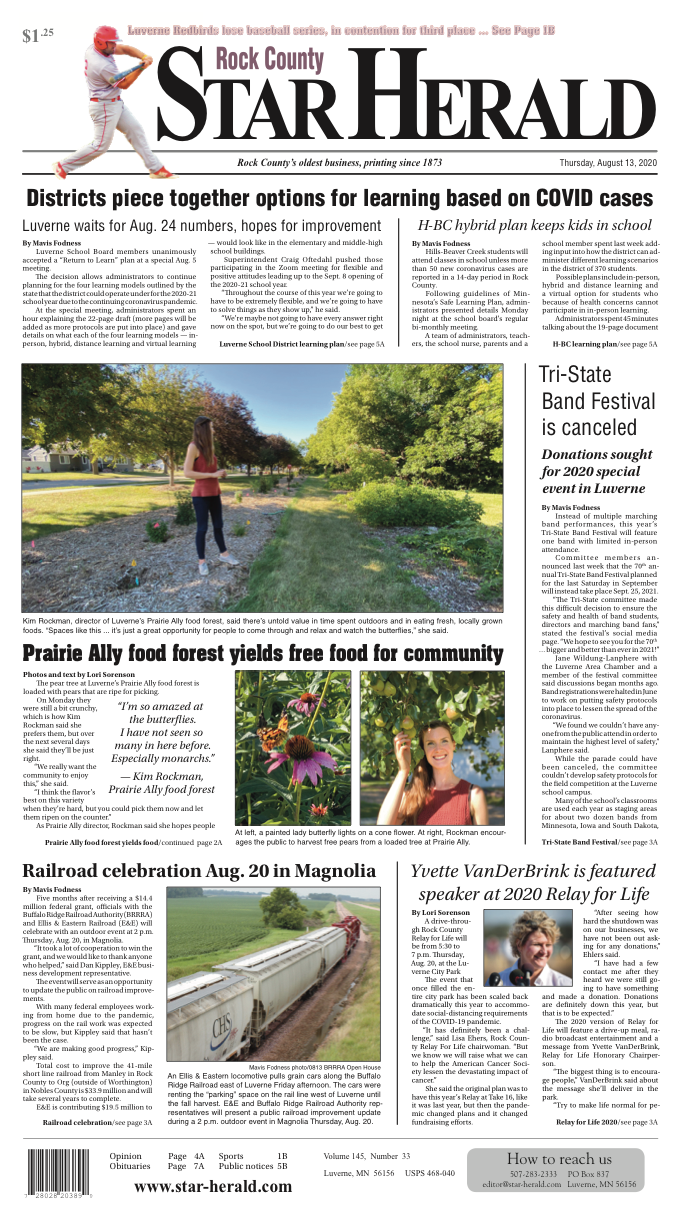
Prairie Ally food forest yields free food for community

The pear tree at Luverne’s Prairie Ally food forest is loaded with pears that are ripe for picking.
On Monday they were still a bit crunchy, which is how Kim Rockman said she prefers them, but over the next several days she said they’ll be just right.
“We really want the community to enjoy this,” she said. “I think the flavor’s best on this variety when they’re hard, but you could pick them now and let them ripen on the counter.”
As Prairie Ally director, Rockman said she hopes people take advantage of Luverne’s food forest, which was planted in 2018 with help from grants and local volunteers to benefit anyone who’s interested.
Those benefits extend beyond nutritional value.
“I think that one opportunity with COVID is that it’s allowed everybody permission to slow down,” Rockman said.
“Spaces like this, even though there’s not a lot of food being produced yet, it’s still just a great opportunity for people to come through and relax and watch the butterflies.”
Rockman offered a tour Monday and progress update of Prairie Ally, which won’t be mature enough to support full community use for a few more years.
Young trees are starting to yield apples. Plus, there are cherry and plum trees and a host of lesser known fruit and nut species that are gaining popularity for their hardiness and health benefits.
These include serviceberry, elderberry, aronia berry, honeyberry, hazelnut, and paw paw. 
Plus, there are grapes, currants, strawberries, gooseberries and even annual vegetables.
An herb garden sports fragrant sage, chives, oregano and basil.
Tiny leaves sprout from the ground next to a stake labeled, “New Jersey Tea,” which Rockman said tells a story.
“This is a fun one,” Rockman said. “It was used by Native Americans, but then during the Revolutionary War, the Europeans would use it as a tea substitute. … They’ll eventually turn into 3-by-5-foot bushes.”
She picks a leaf of anise hyssop, which is good for pollinators. “Do you like licorice?” she asks. “They taste really sweet, actually.”
A row of asparagus shoots is getting established for its first picking in 2022.
Random plants, such as turnips, serve as ground cover, and Rockman noticed that one horseradish plant had finally spread to become another one.
In the late afternoon sun Monday, dozens of butterflies danced atop blooming flowers.
“I’m so amazed at the butterflies,” Rockman said Monday. “I have not seen so many in here before. Especially monarchs.”
While people can pick the flowers to enjoy their color, she said some, like purple coneflowers (Echinacea), sunflowers and sun chokes have other uses.
“I would prefer that people leave them unless they’re going to use them for medicinal purposes,” she said.
“Even on the Echinacea, the leaves and the stems can also be used. You just dry them for tea, or make a tincture.”
Most of Prairie Ally’s food forest is comprised of perennials that return each year on their own, but for it to thrive, volunteers are needed for mulching, planting, fencing and weeding.
Funds are needed for materials and community outreach, and a recent sizeable grant from Blue Cross Blue Shield Center for Prevention was put to use this year for these items and new interpretive signs to identify varieties of plants, shrubs and trees.
In the near future, grant funds will be used for picnic tables on the north end in the circle beds, and plans are afoot to commission artists for three sculptures.
“We’re going to be reaching out to the community — we want to incorporate pieces of old farm and garden equipment,” Rockman said.
“The idea is to do a bit of story-telling and history and ag appreciation.”
With the pandemic, several community events were canceled, but videos about Luverne’s Prairie Ally can be found on the Project Food Forest YouTube channel.
Rockman can be reached at prairieallymn@gmail.com, facebook.com/prairieally, Instagram @prairieallymn or 605-951-0227.

Railroad celebration Aug. 20 in Magnolia

Five months after receiving a $14.4 million federal grant, officials with the Buffalo Ridge Railroad Authority (BRRRA) and Ellis & Eastern Railroad (E&E) will celebrate with an outdoor event at 2 p.m., Aug. 20 in Magnolia.
“It took a lot of cooperation to win the grant, and we would like to thank anyone who helped,” said Dan Kippley, E&E business development representative.
The event will serve as an opportunity to update the public on railroad improvements.
With many federal employees working from home due to the pandemic, progress on the rail work was expected to be slow, but Kippley said that hasn’t been the case.
“We are making good progress,” Kippley said.
Total cost to improve the 41-mile short line railroad from Manley in Rock County to Org (outside of Worthington) in Nobles County is $33.9 million and will take several years to complete.
E&E is contributing $19.5 million to improve the rail line owned by Rock and Nobles counties, and each entity has commissioners who served on the railroad authority.
E&E signed a 15-year lease with the BRRR in 2017 but with extensions could push the agreement out to 99 years.
E&E, owned by Sweetman Construction Co. of Sioux Falls, also operates the rail line from Manley to Ellis, South Dakota. The South Dakota portion of the railroad will also undergo extensive improvements.
Currently the poor condition of the rail on the South Dakota portion of the line prevents E&E from running railcars west of Luverne to Manley, but the line fulfills an industry need as a leased “parking lot” for empty rail cars.
“We get called constantly for car storage,” Kippley said.
Without the short line storage, the main line railroads would be limited in the transfer of loaded railcars to their destinations, Kippley said.
The BRRR connects to the Burlington Northern Sante Fe to the west and the Union Pacific to the east.
Currently hundreds of grain cars are parked on the rails west of Luverne.
“When the grain harvest starts in the fall, they will be all gone,” Kippley said.

Yvette VanDerBrink is featured speaker at 2020 Relay for Life

A drive-through Rock County Relay for Life will be from 5:30 to 7 p.m. Thursday, Aug. 20, at the Luverne City Park
The event that once filled the entire city park has been scaled back dramatically this year to accommodate social-distancing requirements of the COVID-19 pandemic.
“It has definitely been a challenge,” said Lisa Ehers, Rock County Relay For Life chairwoman. “But we know we will raise what we can to help the American Cancer Society lessen the devastating impact of cancer.”
She said the original plan was to have this year’s Relay at Take 16, like it was last year, but then the pandemic changed plans and it changed fundraising efforts.
“After seeing how hard the shutdown was on our businesses, we have not been out asking for any donations,” Ehlers said.
“I have had a few contact me after they heard we were still going to have something and made a donation. Donations are definitely down this year, but that is to be expected.”
The 2020 version of Relay for Life will feature a drive-up meal, radio broadcast entertainment and a message from Yvette VanDerBrink, Relay for Life Honorary Chairperson. 
“The biggest thing is to encourage people,” VanDerBrink said about the message she’ll deliver in the park.
“Try to make life normal for people going through it. Don’t treat them like they have a disease and they’re about to croak.”
VanDerBrink, an auctioneer and land real estate broker, was diagnosed with breast cancer in 2007. She completed surgery, chemo and radiation treatments in October 2008.
Through it all, she powered through 19 auctions in five different states, possibly in an attempt to prove she was “normal.”
She did come through cancer free, but later she suffered from post-traumatic stress syndrome. She said encouragement from others sustained her.
“If you treat someone with positive encouragement, it can help them with better outcomes,” VanDerBrink said.
VanDerBrink is married to Steve, and their children are Emily and Johnathon.
Ehlers said she hopes the community supports the American Cancer Society, despite the pandemic limitations.
“We still need those critical funds to keep making progress in the fight against cancer, so we welcome and encourage people to go to our website at www.relayforlife.org/rockcountymn and donate if they are able,” she said.
“We hope people will come to the park and enjoy the freewill donation drive-thru meal, listen to some music in their cars and hear Yvette speak. “
Relay for Life poster boards (instead of luminary bags) are available for a freewill donation at Salon 75 or First Farmers & Merchants Bank, or people can make their own posters with tagboard. 
A virtual 5K can be run or walked anytime Aug. 20-23.
Register and get a T-shirt at luvprintexpress.com/relay5k. Survivor names can be sent to luvrockrelay@gmail.com to be put on luminary bags.

Volunteers assemble, distribute gift bags

More than a dozen volunteers with A.C.E. of SW Minnesota packed 300 reusable cloth bags with free essential products at Grand Prairie Events in Luverne Monday.
They donned facemasks and put distance between each other while filling each bag with toiletries like shampoo, conditioner, toothbrushes and toothpaste, deodorant and toilet paper.
“We want to help people get through these trying times,” said Linda Wenzel, the Rock County A.C.E. volunteer coordinator.
Wenzel is also a member of  #Luv1LuvAll along with elementary school counselor Marie Atkinson-Smeins.
Earlier this year, Wenzel and Atkinson-Smeins requested a $5,000 grant from the Southwest Initiative Foundation.
The City of Luverne Angel Fund was given $1,000 of the grant to assist residents who are behind on utility bills. The rest of the grant was used to purchase products for the gift bags.
“What gave me the idea is that my church gives comfort kits using trial-sized items,” Wenzel said. “I thought, ‘Why not go bigger?’”
However, the full-sized bottles of personal care products are also more expensive, so Rock County Food Shelf organizers and Sunshine Foods of Luverne helped stretch the grant money at wholesale cost, rather than at retail prices.
Sunshine also donated candy bars and a portion of the $10 gift cards to be used at the store.
“If we had to buy all this, it would easily retail for $8,000,” Wenzel said.
The essential products were distributed Monday across all age groups from young college students to families to retirees.
Wenzel has already received positive feedback.
“Linda, the bags are wonderful,” read one message. “Who do we thank?”
The #Luv1LuvAll is a group of community members tasked to create opportunities that help and/or support individuals and families move above deficiencies outside their control. They contributed $500 toward the project.
The 300 gift bags were intended to relieve the social isolation and economic toll the coronavirus pandemic has had on members of the community.
They were distributed to neighborhoods in the community identified by organizers as areas potentially in need.

Subscribe to

You must log in to continue reading. Log in or subscribe today.