

School News May 30, 2019

Severtson honored by peers
The University of Minnesota Duluth Office of Student Life and Kirby  Student Center  honored Lexie Severtson, a biology major from Luverne, with the Leadership Certificate at the Leadership Awards Reception April 29. The certificate is presented to students who have excelled in academics, community service, additional learning outside the classroom and personal reflection.
Note: The Star Herald received inaccurate information from UMD for last week’s article.
 
Area students graduate from LATI
The following local students graduated from Lake Area Technical Institute in Watertown, South Dakota, on Friday, May 10:
Luverne: Ashley Van Wettering, dental assisting; Jared Jose, heavy equipment operator.
Ellsworth: Jared Leuthold, diesel technology.
Kenneth: Kristoffer Severtson, welding technology. Severtson also qualified for the president’s list for the Spring 2019 semester with a GPA of 3.5 or higher.
 
Taubert named to dean’s list
Carey Taubert, Beaver Creek, was named to the dean’s list for the Spring 2019 semester at Morningside College in Sioux City, Iowa. To be eligible, students must earn a minimum of a 3.67 grade point average with at least 12 graded credits.
Taubert is a senior majoring in nursing.
 
Luverne grad joins academic society
Luverne High School graduate Faith Mounce, Hills, was invited to be part of the National Society of High School Scholars, which recognizes students for academic achievement, leadership and community involvement.
To be eligible, students must have a GPA of 3.5 or better and an ACT score of at least 26 and pay a $75 membership fee.
 
Dingmann graduates from U of M
Jordan Dingmann, son of Dan and Monica Dingmann, Adrian, graduated Friday, May 17, from the University of Minnesota, Minneapolis, with a Bachelor of Science degree in mortuary science.
Jordan is a fifth-generation funeral director and will join his parents’ business at Dingmann Funeral Home and Cremation Services in Luverne.
 
Area students named to Southeast Tech president’s list
Southeast Technical Institute in Sioux Falls, South Dakota, has released the Spring 2019 semester president’s list recipients. To qualify, students must earn a grade point average of 3.5 or higher.
Area students named to the list are Blair Altman, diagnostic medical sonography; Timothy Lingen, automotive technology; Haley Pap, early childhood specialist; Melissa Wood, business administration; and Justice Dunn, digital media production technology.
 
SDSU announces dean’s list
Several area students have been named to the dean’s list for the Spring 2019 semester at South Dakota State University in Brookings. To be named, students must earn a minimum of a 3.5 grade point average with at least 12 graded credits. Students with an asterisk following their names earned a 4.0 GPA.
The following code lists the major of each student:
SAFES: Agriculture, Food and Environmental Science.
SAHSS: Arts, Humanities and Social Science.
SEHS: Education and Human Sciences.
SENGR: Engineering.
SNS: Natural Sciences
SNURS: Nursing
SPAHP: Pharmacy and Allied Health Professionals.
The following students were named to the dean’s list:
Adrian: Madisyn Dingmann SEHS; Skylar Hieronimus, SAFES; Jacquelyn Hokeness, SAFES; Rylie Hokeness, SEHS.
Ellsworth: Jesse Kramer, SENGR; Cole Meester* SENGR; Megan Jo Popkes SAFES.
Hills: Trenton Bass, SENGR; McKenna Westphal, SNURS.
Kenneth: Melissa Tweet, SAHSS.
Lismore: Megan Tweet, SNS.
Luverne: Mariah Aukes, SNURS ; Tanner Baustian, SAFES; Jenae Hamann, SEHS; Alexis Henrichs*                 SAFES; Tessa Klarenbeek, SAHSS; Parker Kooima, SEHS; Aric Meinerts, SENGR; Shelbie Nath, SAHSS; Nicholas Overgaard, SAFES; Daniel Tofteland                * SAFES; Erik Tofteland* SNS; Jacob Van Santen, SAFES; Benjamin Wagner, SENGR; Danielle Watts-Boll* SAHSS.

Don Etrheim

Donald Etrheim
Donald Kenneth Etrheim, 90, Jasper, died Tuesday, May 21, 2019, at the Minnesota Veterans Home in Luverne.
A funeral service was Saturday, May 25, at the Jasper Evangelical Lutheran Church in Jasper. Burial was in the Jasper City Cemetery.
Donald Etrheim was born (and baptized) on Dec. 1, 1928, to Norwegian immigrants Sven and Randveig “Randy” (Gjeide) Etrheim on the family farm in Rock County, Minnesota, near Valley Springs, South Dakota. He was the firstborn American citizen in the family. The family moved to Balaton where he attended country school and then Balaton High School. He was confirmed at the Florence Lutheran Church in Florence. He helped on the family farm and for neighboring farmers and had many 4-H projects. In 1945 the family moved to Jasper, and Donald attended Jasper High School, graduating in 1947.
In December 1950 he enlisted in the United States Navy. He served on the USS Piedmont AD 17 for four years. He received his honorable discharge and returned to Jasper to farm.
On June 1, 1957, he married Devonna Zweep in Garretson, South Dakota. They made their home on a farm east of Jasper. In 1999 he retired after a traumatic brain injury accident. After 2 1/2 years of physical therapy, he was able to enjoy life again.
Donald was an active member of the Jasper Evangelical Lutheran Church in Jasper. He was a charter member of the Arthur Moeller American Legion Post 478 of Hardwick and a lifelong member of the Pipestone VFW Post 3814. He was also a member of the Jasper Lions Club, the Eden Rural Fire Board, the Ihlen Senior Citizens, the Sons of Norway and the Hollyhock Square Dance Club. 
In April of 2018 Donald moved to the Minnesota Veterans Home in Luverne.
Donald enjoyed dancing, especially polkas and waltzes. He always said, “You can’t be sad dancing.” He also enjoyed reading Louis L'Amour books, bowling, and helping friends. Near retirement, Donald learned to make lefse, candy, and cookies. Donald enjoyed attending the activities and events of his children and grandchildren.
Donald is survived by his wife, Devonna, of Jasper; five children, Bryan (Donna) Etrheim of Garretson, Robert (Lori) Etrheim of Tyler, Dianne (Brad) Johnson of Russell, Daniel (Chrisann) Etrheim of Brandon, South Dakota, and John (Sheila) Etrheim of Sioux Falls, South Dakota; 16 grandchildren, Nicole (Dave) Trudeau, Tyler (Denielle) Etrheim, Lindsey and Austin Etrheim, Chelsey (Josh) Jackson and Brant (Liz) Etrheim, Rachel, Krista and Ross Johnson, Charissa, Trey and Brooke Etrheim, Brody, Megan, Elise and Griffin Etrheim; five great-grandchildren; one brother, Harold (Dallas) Etrheim of Hardwick; sisters-in-law Shirley Etrheim of LaCrescent and Darlene Zweep of Garretson; and one brother-in-law, Donald Zweep of Brandon.
He was preceded in death by his parents; two brothers, James and Roger (Jeanette) Etrheim; a sister, Beverly (Dale) Radi; one sister-in-law, Flora Zweep; one brother-in-law, Lloyd Zweep; and his mother- and father-in-law, John and Katie Zweep.
Memorials are preferred to the Minnesota Lions Vision Foundation, the Jasper Fire Department and the Jasper Ambulance Association.
Arrangements were provided by Hartquist Funeral Home of Pipestone, www.hartquistfuneral.com.
(0530 F)

Trump's MFP provisions complicate prevented planting decisions

Farm operators in many portions of the Midwest, including parts of southern Minnesota, northern Iowa, and eastern South Dakota will likely not be able to plant a portion of their 2019 corn and soybeans crops by the crop insurance “final planting dates” for their area. Those farmers have been evaluating their crop insurance coverage for prevented planting payments, as compared to the yield and profit potential for late-planted corn and soybeans. The prevented planting decision became more difficult for many crop producers following the USDA announcement regarding potential 2019 market facilitation program (MFP) payments.
On May 23, USDA announced preliminary details for $14.5 billion in 2019 MFP payments that could potentially be made to producers. The MFP payments will again be administered through Farm Service agency (FSA) offices.
Following is a brief summary of the 2019 MFP payment details:
•Producers of corn, soybeans, wheat, alfalfa hay, barley, canola, crambe, dry peas, extra-long staple cotton, flaxseed, lentils, long and medium grade rice, mustard seed, dried beans, oats, peanuts, rapeseed, safflower, small and large chickpeas, sorghum, sunflower seed, temperate japonica rice and upland cotton are eligible for MFP payments in 2019.
•Payments will be based on the total planted acres to those crops on a given farm unit and will not be dependent on which specific crops were planted in 2019.
The total acres eligible for 2019 MFP payments can not exceed the amount of eligible crop acreage that a farmer planted in 2018, except for any crop acres that were added in 2019 due to land purchases, land rental contracts, family arrangements, etc. This does not include converted CRP acres.
•As it stands now, 2019 prevented planted crop acres will not be eligible for 2019 MFP payments.
•The 2019 MFP payments will be paid on a single county payment rate. (Details of the payment formula have not yet been announced.) 2018 MFP payments were based on the actual crop production (bushels produced) times an established payment rate ($1.65/Bu. for soybeans, $.14/Bu. for wheat, and $.01/Bu. for corn); however, the 2019 MFP payment formula will be vastly different.
•Hog producers will again qualify for potential MFP payments, based on their hog and pig inventory at a specified date (not yet announced), and dairy producers will earn a 2019 MFP payment based on their production history (similar to 2018 MFP payments).
•2019 MFP payments are scheduled to be made in three different tranches (or rounds), with the first round occurring in late July or early August following the required crop acreage reporting deadline of July 15 at FSA offices. The second and third rounds of payments will be made in November, 2019 and January, 2020, based on an evaluation of continuing trade related impacts on the affected agricultural commodities.
The biggest provision impacting crop producers in areas that are affected by the continued planting delays is the requirement than crops must be planted in order to be eligible for 2019 MFP payments on those acres; however, it does not specify what crop must be planted. Once a producer plants any crop on the unplanted crop acres, those acres will lose the opportunity for prevented planting crop insurance payments in 2019. For most Midwest farmers, this means a choice of planting very late planted corn or late planted soybeans on those acres, in order to maintain eligibility for potential MFP payments.
Once the crop insurance “final planting date” for corn or soybeans has been reached, farm operators can opt to take the prevented planting insurance coverage, if they have that coverage option, rather than planting the crop. A large majority of producers in the Upper Midwest carry revenue protection (RP) crop insurance with prevented planting coverage on their corn and soybeans. If they choose the prevented planting coverage, they will receive 55 percent of their original crop insurance guarantee for corn and 60 percent for soybeans on a specific farm unit.
One alternative is to plant the original crop during the 25-day late planting period. Following the “final planting date” for a crop, there is reduction of one percent per day in the crop insurance guarantee (from the maximum guarantee) for that crop. For example, corn in Southern Minnesota planted on June 10 would have a crop insurance guarantee that is 90 percent of the original maximum guarantee. The other alternative would be to plant another crop on those acres after the “final planting date”. For example, soybeans could be planted on intended corn acres after May 31. In that case, there would be no prevented planting coverage payment eligibility for the corn acres, and the soybeans would be treated as insurable soybean acres.
 
Following are the final planting dates for corn and soybeans at various locations:
CORN
•May 25 in northern Minnesota, extreme northern Wisconsin, most of Nebraska, and most counties in North and South Dakota.
•May 31 in the southern two-thirds of Minnesota, all of Iowa, most counties in Wisconsin, and a few counties in southeast North and South Dakota.
•June 5 in Illinois, Indiana, Ohio, and most of Michigan.
 
SOYBEANS
•June 10 in most counties in Minnesota, Nebraska, North and South Dakota, the northern two-thirds of Wisconsin that are eligible for crop insurance.
•June 15 in all of Iowa, the southern one-third of Wisconsin, the northern one-third of Illinois, and most counties in Michigan.
•June 20 in Indiana, Ohio, and the balance of Illinois.
Many farm operators are already dealing with the stress of likely yield reductions from delayed or prevented planting, as well as very tight profit margins for the current year. The 2019 MFP factor adds even more stress to making a decision on whether or not to opt for prevented planting this year. They must now “weigh-in” the economics of possibly receiving potential 2019 MFP payments, of which they do not know the payment formula or an estimated amount, versus the known payment amount of their prevented planting crop insurance coverage. If they choose to plant a crop very late to protect the MFP payments, knowing they will get reduced yields, they will lose the prevented planting protection.
Farm operators that are facing prevented planting decisions should contact their crop insurance agent for details and information.
Kent Thiesse, Farm Management Analyst, has prepared an information sheet titled “Late and Prevented Planting Options for 2019” which contains details on prevented planting requirements and considerations. To receive a copy of the prevented planting information sheet, please send an email to:  kent.thiesse@minnstarbank.com.

Church news May 30, 2019

St. Catherine Catholic Church
203 E. Brown St., Luverne
St. Catherine Ph. 283-8502; email: stcatherine@iw.net
Friday, May 31: 10 a.m. Mass at Poplar Creek. Saturday, June 1: 5 p.m. Mass at St. Leo. Sunday, June 2: 8:30 a.m. Mass at St. Catherine. 10:30 a.m. Mass at St. Leo. 1 p.m. Bilingual Mass at St. Leo. June 3-7 Service over Self Rock the Edge Youth Mission Week. Tuesday, June 4: 9:30 a.m. Walking with Purpose. 1-4 p.m. Mission Sewing. Wednesday, June 5: 9 a.m. Mass at St. Catherine. 7 p.m. Walking with Purpose.
 
Luverne Christian Reformed Church
605 N. Estey St., Luverne
Office Ph. 283-8482; Prayer Line Ph. 449-5982
www.luverncrc.com — office@luvernecrc.com
Roger Sparks, Pastor
Sunday, June 2: 9:30 a.m. Worship service. 6:30 p.m. Evening worship service.
 
First Baptist Church
1033 N. Jackson St., P.O. Box 975, Luverne
Ph. 283-4091; email: fbcluv@iw.net — www.fbcluverne.org
Walt Moser, Pastor
Sunday, June 2: 9:15 a.m. Sunday School. 10:30 a.m. Morning service. 6 p.m. Evening service. Tuesday, June 4: 7 a.m. Men’s Bible Study. Thursday, June 6: 6 a.m. Men’s Bible Study. 8 p.m. Worship service on Channel 3.
 
Grace Lutheran Church
500 N. Kniss Ave., Luverne
Ph. 507-283-4431; www.graceluverne.org — graceluverne@iw.net
Ron Nichols, Pastor
Thursday, May 30: 8:30 a.m. Missions in Action. Friday, May 31: 6:30 p.m. Worship on Channel 3. Saturday, June 1: 5:30 p.m. Worship with Communion. Sunday, June 2: 8:15 a.m. Radio Broadcast. 9 a.m. Worship with Communion. 10 a.m. Special Congregational Meeting; fellowship coffee. Monday, June 3: 4:30 p.m. Worship on Channel 3. Tuesday, June 4: 9 a.m. Staff meeting. Wednesday, June 5: 7 a.m. Men’s Bible Study. 10 a.m. Worship at Tuff Home. 1 p.m. GLCW Executive Meeting. Thursday, June 6: 8:30 a.m. Missions in Action.
 
Bethany Lutheran Church
720 N. Kniss Ave., Luverne
Ph. 507-283-4571 or 507-449-0291 or 605-215-9834
pastorapalmquist67@yahoo.com
Sunday, June 2: 9:15 a.m. Bible Class. 10:15 a.m. Worship. Wednesday, June 5: 9:30 a.m. Rebekah Circle.
 
American Reformed Church
304 N. Fairview Dr., Luverne
Ph. 283-8600; email: office@arcluverne.org
Mike Altena, Pastor
Friday, May 31: 6:30 a.m. Community Men’s Bible Study. 4:30 p.m. REFIT Fitness. Sunday, June 2: 9:30 a.m. Worship. 7 p.m. Senior High Youth Group. Monday, June 3: 5:30-7:30 p.m. 50s Night Fundraiser. 7 p.m. Esther Circle. Tuesday, June 4: 1:30 p.m. Rebecca Circle. 4 p.m. Commons reserved. Wednesday, June 5: 4:30 p.m. REFIT Fitness. 6 p.m. Ladies Night Out. 6:30 p.m. VBS Set-up night. 7 p.m. Praise Team.
 
First Assembly of God Church
1075 110th Ave., 2 miles west of Luverne on County Rd. 4
Sundays: 9 a.m. Sunday School. 10 a.m. Morning Worship. 6:30 p.m. School of the Holy Spirit. Wednesdays: 7 p.m. Kids Connection; Men’s Bible Study with Pastor Ken; Women’s Bible Study with Pastor Gloria.
 
United Methodist Church
109 N. Freeman Ave., Luverne
Ph. 283-4529; email: luverneumc@iw.net
Thursday, May 30: 1-3 p.m. Rock County Food Shelf. Friday, May 31: 5-8 p.m. Pie and ice cream social in courtyard. Saturday, June 1: 8 p.m. AA Meeting. Sunday, June 2: 9 a.m. Coffee Hour and Adult Sunday School. 10 a.m. Outdoor worship service. 4:30 p.m. Genesis/Revelation Bible Study. No ALIVE Youth Group. Monday, June 3: Service over Self Mission Week begins. 8 p.m. AA Meeting. Tuesday, June 4: 8 a.m. Priscilla Circle. Wednesday, June 5: 8 p.m. AA Meeting. Thursday, June 6: 1-3 p.m. Rock County Food Shelf.
 
First Presbyterian Church
302 Central Lane, Luverne
Ph. 283-4787; email: Firstpc@iw.net— www.fpcluverne.com
Thursday, May 30: 10 a.m. Worship on Channel 3. Sunday, June 2: 9:30 a.m. Worship Service. 10:30 a.m. Coffee and Fellowship. Tuesday, June 4: 10 a.m. and 6 p.m. Worship on Channel 3. Wednesday, June 5: 6:30 p.m. Property. 7 p.m. Stewardship. 7:30 p.m. CE and worship.
 
St. John Lutheran Church
803 N. Cedar St., Luverne
Ph. 283-2316; email: stjohn@iw.net
www.stjohnlutheranluverne.org
Gary Klatt, Pastor
Thursday, May 30: 11:30 a.m. DCE Jess Devotions at Mary Jane Brown Home. Saturday, June 1: 5:30 p.m. Worship. Sunday, June 2: 9 a.m. Worship. 3 p.m. Crafternoon. June 3-7: Service over Self Rock the Edge Youth Mission Week. Monday, June 3: 7 p.m. Elders meeting. Tuesday, June 4: 10 a.m. and 6 p.m. Worship on Channel 3. 1 and 6:30 p.m. Quilting. Wednesday, June 5: 9:30 a.m. Bible Study. 7 p.m. Kingdom Builders. Thursday, June 6: 2 p.m. Women’s Society. 5:30 p.m. VBS training.
 
Living Rock Church
500 E. Main St., Luverne
Ph. 449-0057; www.livingrockswmn.org
Billy Skaggs, Pastor
Sundays: 10:30 a.m. Worship; Kids Rock Children’s Ministry. 6 p.m. Youth Ministry. Life groups meet throughout the week.
 
New Life Celebration Church
110 N. Oakley, Luverne
Ph. 449-6522; email: newlifecelebration@gmail.com
Sundays: 9:30 a.m. Worship Service at 110 N. Oakley. Every third Thursday: 4:30 p.m. Food give-away at Generations Building. Bible Study groups meet at various times and days.
 
Zion Evangelical Lutheran Church
305 E. 2nd St., P.O. Box 36, Hardwick
Thursday, May 30: 3:30 p.m. Worship service on Channel 3. Friday, May 31: 3:30 p.m. Worship on Channel 3. Sunday, June 2: 10:30 a.m. Worship. Thursday, June 6: 3:30 p.m. Worship service on Channel 3.
 
Ben Clare United Methodist Church
26762 Ben Clare Ave., Valley Springs, S.D.
igtwlb@WOW.net
Bill Bates, Pastor
Sundays: 9 a.m. Worship; 10 a.m. Fellowship; 10:30 a.m. Sunday School for all ages.
 
First Lutheran Church
300 Maple St., Valley Springs, S.D.
Ph. (605) 757-6662
Laura Phillips, Pastor
Sunday, June 2: 10 a.m. Combined worship with Communion at First Lutheran.
 
Palisade Lutheran Church
211 121st St., Garretson, S.D.
Ph. (507) 597-6257 — firstpalisade@alliancecom.net
Laura Phillips, Pastor
Sunday, June 2:.10 a.m. Combined worship with Communion at First Lutheran. Saturday, June 8: 10 a.m. Adopt-A-Highway. Pizza will follow at Palisade Lutheran.
 
First Presbyterian Church
201 S. 3rd St., P.O Box 73, Beaver Creek
Ph. 507-935-5025
email: lori.firstpres@gmail.com
Sundays: 9:30 a.m. Morning Worship.
 
Magnolia United Methodist Church
501 E. Luverne St., Magnolia
Pastor Nancy Manning
Ph. 605-215-3429
email: magnoliamnumc@gmail.com
Sundays: 9 a.m. Magnolia Worship Service. Wednesdays: 6:30 p.m. Confirmation.
 
Steen Reformed Church
112 W. Church Ave., Steen
Ph. 855-2336
Jeremy Wiersema, Pastor
Sundays: 9:30 a.m. Worship; service broadcast on KQAD. 10:45 a.m. Sunday School. 6 p.m. Youth Group. Evening worship at 6 p.m. first and third Sundays. Wednesdays: 7 p.m. Midweek.
 
Bethlehem Lutheran Church
Pastor Maggie Berndt-Dreyer
112 N. Main St., Hills
Ph. 962-3270
e-mail: bethlehemluth@alliancecom.net
Saturday, June 1: Basement reserved for bridal shower. Sunday, June 2: 9 a.m. Communion at Tuff Chapel. 10 a.m. Communion at Bethlehem. Tuesday, June 4: 2:30 p.m. Bible Study at Tuff Chapel. 3:15 p.m. Bible Study at Tuff Village. Wednesday, June 5: 9 a.m. Quilting.
 
Hills United Reformed Church
410 S. Central Ave., Hills
Office Ph. 962-3254
hillsurc@alliancecom.net
Alan Camarigg, Pastor
Sundays: 9:30 a.m. and 6 p.m. Worship Services.

Blessing, challenge of graduation

“Choose this day whom you will serve.”(Joshua 24:15)
High school graduation is a rite of passage unlike any other. You move from being treated like a child (legally) to being counted an adult, both in society and in any academic setting you might enter. Childhood is over. Adulthood beckons. How should you respond to the blessing and challenge?
1. Own your faith. If you come from a Christian home, you have benefited tremendously from a host of supportive circumstances (household rules, numerous protections, church life).
Testing awaits as you enter the world. It won’t be enough to ride the coattails of your parents’ faith. If you’re not sure about Christianity, now is the time to settle the matter (Ecclesiastes 12:1). Christianity is a faith unlike any other because it’s based on historical events that were verifiable to thousands of people in Christ’s day (1 Corinthians 15:3–6, 12–14).
If you have doubts, ask away. The existence of God, the reliability of the Bible, the resurrection of Jesus, Jesus being the only way to God — there is a wealth of material which addresses these and other questions.
But do you want to base your life on Jesus Christ? You’ll soon encounter new opportunities to misuse God’s good gifts in ways that seem alluring — that seem to offer immediate pleasure. Will you believe the lie that God is a cosmic killjoy, out to rob you from experiencing the good things of life (Genesis 3:6)? Or will you trust that the One who made you knows best, that his rules are an expression of his love, and that his ways lead to your greatest happiness (Psalm 16:11)?
2. Own your relationships. The Christian faith is lived out in community. So you’ll need to find a good church where you can worship, learn, grow, and serve, where you can form friendships and where you can be a friend. Make church attendance a priority early. It’s a harder habit to form later.
At college, the easiest friendships aren’t always the best. To become wise, you need to walk (or do life) with the wise (Proverbs 13:20). Look for others who share your commitment to the things of God and faithfully invest in them. Relational evangelism is worth pursuing, especially at college, but make sure you also nurture friendships that strengthen your faith (Proverbs 27:17). We’re commanded to be salt and light (Matthew 5:13–16) — which presupposes we are salt and light. To make a difference in the world we must be different than the world and live a holiness in lifestyle, combined with a gracious demeanor.
3. Own your decisions. The next few years are full of choices — which college (or trade) to pursue, what to study, how to pay for it, and more. It might be nice if God spoke with an audible voice at each crossroads, but that’s not been my experience. We should pray (James 1:5). We should seek counsel from trustworthy people who know us (Proverbs 15:22). We should consider where we’ve been successful and what activities we enjoy, as these point to where, over time, we might be most useful in this world for the good of others and the glory of God.
Panicked that you’ll miss God’s will? God wants us to follow him more than we do. His moral will is revealed in the Bible. His sovereign will is revealed as we live it. So make the best decisions you can based on sound judgment, accept the consequences, learn from any missteps, and trust God to shower you with mercy and goodness (Psalm 23:6).
Congratulations on your graduation. Godspeed in the days ahead. Grace be with you to the end.

Poverty is alive and well in Rock County; just ask the high school students

In the April 30 poverty simulation at Grand Prairie Events, Luverne High School student Alyssa Nattress was assigned the role of a 9-year-old whose mother was in prison and her father wasn’t in the picture.
She and her 7-year-old brother lived with their disabled grandpa and their grandma who worked full time and couldn’t tend to them much because of her work hours.
Nattress described the hardships of living in a dangerous neighborhood where they were robbed and they robbed from others to meet basic needs. They were even sold into sex trafficking with the promise of better opportunities, only to find themselves victimized again.
“This was an eye-opener for me,” Nattress wrote in a paper for her high school economics class taught by David Rysdam. “I didn’t realize how many people actually struggle and are in poverty.”
She was one of 23 LHS students who participated in the simulation, sponsored by the Blandin Foundation and the local #Luv1LuvAll advocacy group.
The April 30 event was the second one in Luverne, and it was the second time Rysdam sent students to participate. “The students were engaged, out of their comfort zones and it had an impact on those that needed to hear the message the most,” he said.
Jaden Knips said he went to the simulation for extra credit in Rysdam’s class, but he got a lot more than extra points.
He played the role of a young man just out of prison paying support for a child he never saw and he lived with a woman with a child from a man who didn’t support the child. His full-time job barely paid the bills, and they were on the edge of losing their home.
“Not only did I learn a little bit of what poverty was like, I learned that people in poverty don’t just sit there and do nothing,” Knips said. “They have a bunch of stuff they do every day just to try and make things work.”
Sara Ernst reported a similar experience.
“… Honestly it was one of the most eye-opening experiences I’ve had in a while,” she said about playing the role of a 16-year-old pregnant student who found school to be a safe haven from turmoil at home where only one of her parents had a job.
“We struggled to pay all of our bills and never had money to eat,” she said. “Despite all our efforts, we were evicted.”
Mallory Thorson reported being grateful for a stable home with parents who had stable jobs. Another student, Jocelyn Cazeres, was so moved by the experience she said she’d become a social worker in order to help people.
The students noticed a pattern of exploiting poor people.
“… They are usually impoverished because they get caught in a long cycle of borrowing money, pay a debt, paying the loan off, running into more debt, and so on,” wrote Jordan Winter. 
“I think it ties into what we learned about with monetary policy, with how debt is a normal thing for so many people. It’s just how our society and system works.”
Others simply learned compassion. 
“This experience showed me not to judge people, because you never know what someone is going through in their life or how much they are struggling to be able to provide their family with necessities,” wrote Ali Elsabagh. 
“It helped humble me and made me grateful for everything that I have in my life that I take for granted every day.”
Rysdam said the simulation is an important part of education for the community, and students’ reactions confirm the value of taking them out of the classroom to attend the event.
“I feel that there are lessons that are better learned through experience rather than the text. … We have to make sure that our students are civic-minded contributors to society and their community,” he said.
“Exercises such as these take the students out of their comfort zone and expose them to a part of our community that they may be completely unaware of. People living poverty are not going to tap you on the shoulder and tell you their story; it is often quite the opposite.”
Click on the links below to see all the students’ responses to the poverty simulation.

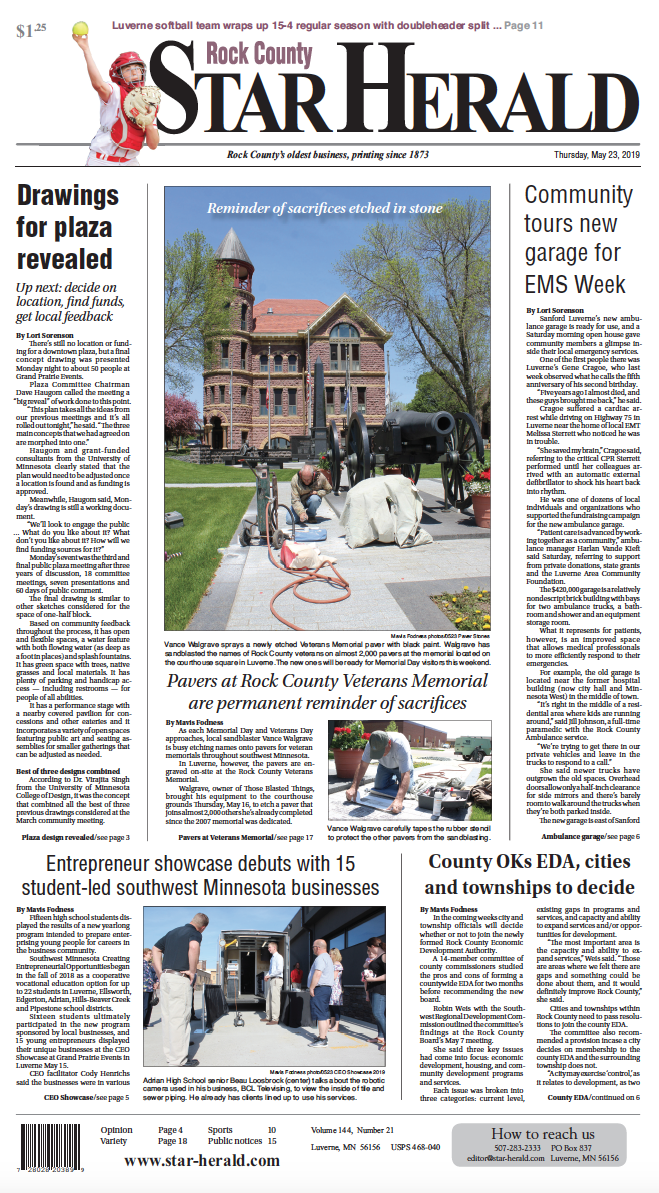
Pavers at Rock County Veterans Memorial area permanent reminder of sacrifices

As each Memorial Day and Veterans Day approaches, local sandblaster Vance Walgrave is busy etching names onto pavers for veteran memorials throughout southwest Minnesota.
In Luverne, however, the pavers are engraved on-site at the Rock County Veterans Memorial.
Walgrave, owner of Those Blasted Things, brought his equipment to the courthouse grounds Thursday, May 16, to etch a paver that joins almost 2,000 others he’s already completed since the 2007 memorial was dedicated.
“Even though it is just one, it’s important to the family,” Walgrave said.
Edward Tofteland’s name was etched on one of the 11-by-4-inch bricks that comprise the walkway from the memorial to the Luverne Street sidewalk.
Tofteland’s son, Joel, of Apple Valley, purchased the paver in remembrance of his dad’s military service.
“I know very little about his military background,” he admitted.
What is known is etched on the paver: Edward Tofteland, Army, WWII.
Joel said his dad, like many other 21-year-olds of that era, was drafted into the military in 1942.
Edward, the only son of Jens and Jenny Tofteland, served about six months before returning to help out at the family farm northeast of Beaver Creek.
Edward farmed until his death in 1983 at age 62.
He married Mary, and the couple had five other children in addition to Joel — Janece, June, Joan, Marvin and Rodney.
They all grew up on the homestead once located northeast of Beaver Creek, near where Marvin Tofteland currently farms.
The Veterans Memorial pavers can be purchased for or by residents who live or have lived in Rock County, were honorably discharged from the armed forces or are currently on active duty. There is no requirement on length of service.
Pavers cost $125, and the funds from the sale of the pavers is used for perpetual care of the monument.
Like his father, Joel Tofteland was also drafted into the military, serving two years in the Army during the Vietnam War.
“All the veterans there deserve recognition,” Tofteland said. “My next challenge is to do one for myself.”
A full list of names etched on the pavers is located at rockcountyveteransmemorial.com, which also has an application form to purchase a paver.

Drawings for plaza revealed

There’s still no location or funding for a downtown plaza, but a final concept drawing was presented Monday night to about 50 people at Grand Prairie Events.
Plaza Committee Chairman Dave Haugom called the meeting a “big reveal” of work done to this point.
“This plan takes all the ideas from our previous meetings and it’s all rolled out tonight,” he said. “The three main concepts that we had agreed on are morphed into one.”
He and grant-funded consultants from the University of Minnesota clearly stated that the plan would need to be adjusted once a location is found and as funding is approved.
Meanwhile, Haugom said, Monday’s drawing is still a working document.
“We’ll look to engage the public … What do you like about it? What don’t you like about it? How will we find funding sources for it?”
Monday’s event was the third and final public plaza meeting after three years of discussion, 18 committee meetings, seven presentations and 60 days of public comment.
The final drawing is similar to other sketches considered for the space of one-half block.
Based on community feedback throughout the process, it has open and flexible spaces, a water feature with both flowing water (as deep as a foot in places) and splash fountains. It has green space with trees, native grasses and local materials. It has plenty of parking and handicap access — including restrooms — for people of all abilities.
It has a performance stage with a nearby covered pavilion for concessions and other eateries and it incorporates a variety of open spaces featuring public art and seating assemblies for smaller gatherings that can be adjusted as needed.
 
The best of three designs combined into one
According to Dr. Virajita Singh from the University of Minnesota College of Design, it was the concept that combined all the best of three previous drawings considered at the March community meeting.
“It’s not so much a big reveal as it is a development,” she said, adding again that the plan will need to be adapted as a location and funding sources are found.
Singh and Master of Landscape Architecture student Haily Schmitz are working with Anne Dybsetter from the University of Minnesota Southwest Regional Sustainable Development Partnership to develop a conceptual design for an outdoor public plaza in downtown. 
The team presented drawings and recommendations Monday night, pointing out key priorities the community had identified that helped shape the final concept:
Does it do what you want it to do? Does it look like what you want it to look like? Does it appeal to kids and youth? Does it appeal to adults?
When people at the meeting were encouraged to ask questions and share ideas, the topic of safety came up in a few different forms, primarily for children.
For example, one person pointed out that a child can drown in only a few inches of water, and another person questioned about safety near traffic.
While the plaza can be adapted to address safety issues, Community Education Director and Plaza Committee member Karen Willers warned against being too safe.
“These are valid concerns, but we tend to overprotect our children,” she said, pointing out the success of the Outdoor Classroom near the elementary school.
“Those kids love to explore, feel, touch, and walk in it. … Yes there have been some skinned knees … but keep in mind the freedom to explore; it’s part of development.”
 
What’s next?
Chamber Director Jane Wildung Lanphere spoke about future steps in the process. For example, the plaza concept will be displayed at the Rock County Fair and it will also be online for community feedback.
There will continue to be plaza events in the History Center parking lot this summer on the third Thursdays in July, August and September.
“That’s not the decided location,” she said. “The History Center has just been gracious enough to let us use their parking lot.”
She also ventured into the possibility of a local half-cent or quarter-cent sales tax to fund the plaza.
“The city council did not suggest this; it’s not for police, fire or streets,” Lanphere said, admitting she’ll “take a lot of heat” for bringing it up.
“It’s something the committee has talked about. … Other communities have done this to pay for local amenities.”
That discussion and other aspects of the plaza will be part of the ongoing development, she said while encouraging community input.
“Let’s have a place where people can go after work to relax and enjoy the outdoors,” Lanphere said. “Let’s make Luverne a really great place for everyone to live.”
Luverne Initiatives for Tomorrow (L.I.F.T.), Luverne Area Chamber, along with other community organizations and businesses have been partnering to host the plaza development process.

Community tours new garage for EMS Week

Sanford Luverne’s new ambulance garage is ready for use, and a Saturday morning open house gave community members a glimpse inside their local emergency services.
One of the first people there was Luverne’s Gene Cragoe, who last week observed what he calls the fifth anniversary of his second birthday.
“Five years ago I almost died, and these guys brought me back,” he said.
Cragoe suffered a cardiac arrest while driving on Highway 75 in Luverne near the home of local EMT Melissa Sterrett who noticed he was in trouble.
“She saved my brain,” Cragoe said, referring to the critical CPR Sterrett performed until her colleagues arrived with an automatic external defibrillator to shock his heart back into rhythm.
He was one of dozens of local individuals and organizations who supported the fundraising campaign for the new ambulance garage.
“Patient care is advanced by working together as a community,” ambulance manager Harlan Vande Kieft said Saturday, referring to support from private donations, state grants and the Luverne Area Community Foundation.
The $420,000 garage is a relatively nondescript brick building with bays for two ambulance trucks, a bathroom and shower and an equipment storage room.
What it represents for patients, however, is an improved space that allows medical professionals to more efficiently respond to their emergencies.
For example, the old garage is located near the former hospital building (now city hall and Minnesota West) in the middle of town.
“It’s right in the middle of a residential area where kids are running around,” said Jill Johnson, a full-time paramedic with the Rock County Ambulance service.
“We’re trying to get there in our private vehicles and leave in the trucks to respond to a call.”
She said newer trucks have outgrown the old spaces. Overhead doors allow only a half-inch clearance for side mirrors and there’s barely room to walk around the trucks when they’re both parked inside.
The new garage is east of Sanford Luverne near the ER services on an accessible street with designated parking for emergency responders to park their private vehicles while they respond to calls.
Until the driveway is complete, trucks will still need to back out, but they’ll later be able to drive through the building via a roundabout access.
Sterile supplies will still be kept in the hospital, but garage storage space will be used for backboards, tools and other frequently needed items.
The roomy bathroom with a shower is also a necessity.
“It’s for decontamination … We clean up after every call,” Johnson said. “A few weeks ago we were in a cattle yard. Sometimes we’re in hazmat situations, or we go from one call to another and we can’t have bodily fluids from the previous call still on us.”
She said all this allows medical professionals to more efficiently respond to emergencies and improves patient outcomes.
The Rock County Ambulance team has 24 members who respond to an average of 1,000 calls per year.
Vande Kieft said the new ambulance garage is an example of local leaders and professionals pooling resources to benefit the community.
The Rock County Ambulance service coordinates with the city of Luverne, Rock County and Sanford to improve emergency response for those who need it.
“The person who wins is the person lying on the ground,” Vande Kieft said. “He doesn’t care who shows up; he just needs help.”
 
Rock County Ambulance service by the numbers
The Rock County Ambulance team has 24 members. This number includes:
•14 emergency medical technicians (three in Hills equipped with response equipment).
•seven paramedics.
•three registered nurses who are EMTs trained in hands-on paramedic duties.
The ambulance responds to an average 1,000 calls per year for the past three years.
Using 2018’s total 992 calls, that translates to 28,454 total call hours for the year in 2018, and it breaks down to an average of 37 hours per week per person on the ambulance team.
But for the medics, (one needs to accompany each call) those numbers are much higher.
“Troy Thone had 4,000 hours last year, and that’s not sustainable,” Vande Kieft said. “Luverne is very fortunate to have the ambulance staff that we have.”
As Rock County’s population continues to age, he said these medical response incidents will continue to increase. Seventy-two is the average age of a person needing local ambulance services.
But as the number of ambulance calls continues to increase, the number of responders is decreasing.
“It’s important for the community to understand what some of these people give.”
Of the 992 calls in 2018:
•577 required advanced life support services (at $1,300 per call).
•257 required basic life support services ($1,000 per call).
•363 were transfers from Sanford Luverne to another hospital ($1,000 to $1,700 per call depending on the level of care needed).
•157 were calls that didn’t require transports, such as lift assists for someone who has slipped off a chair, but still required the minimum $300 ambulance response.
“We don’t bill for these calls, but we still have to pay our staff for their response time,” Vande Kieft said.
“That’s what give back … Sometimes I don’t think the community understands how that works.”
He also explained that Sanford often doesn’t recoup the full cost of ambulance services, because for patients on Medicare and Medicaid, the state reimburses only about half.
“It’s a huge story,” Vande Kieft said.
“We’re constantly working to increase reimbursements. … We apply for grants and we’re doing the best we can because we’re an important part of the community.”
Click the link below for a look at the slideshow about the ambulance garage and services the ambulance members provide.

Subscribe to

You must log in to continue reading. Log in or subscribe today.